
Technical Overview & Applications
An In-Depth Analysis of Long-Wave Infrared (LWIR) Imaging, Radiometric Temperature Measurement, and Non-Contact Quality Inspection
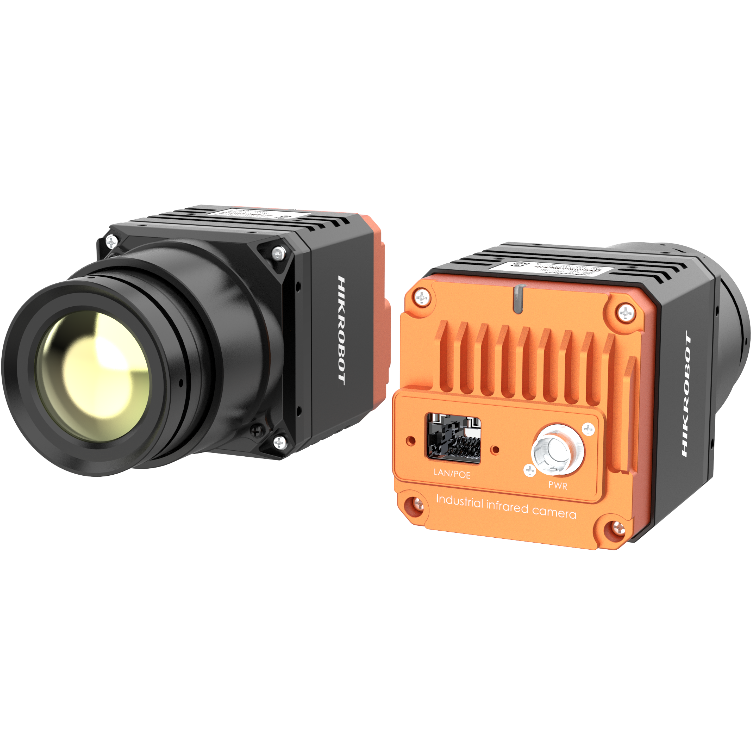
As industrial automation scales toward higher efficiency and non-destructive quality control, traditional optical cameras operating in the visible spectrum face physical limitations when evaluating thermal distribution, structural bonding integrity, or subsurface material anomalies. To address these challenges, Hikrobot developed the CI Series Industrial Long-Wave Infrared (LWIR) Thermal Cameras.
Designed for integration into automated production lines, the CI Series combines high-sensitivity microbolometer technology, real-time temperature radiometric measurement rules, fast response acquisition cycles (~10 ms), and direct compatibility with industry-standard machine vision protocols. Distributed in the UK and Ireland by smartcameras.ai/ Ltd, these thermal cameras support critical non-contact inspection tasks across photovoltaics, food packaging, lithium battery manufacturing, and industrial automotive processes.
Sensor Architecture & Thermal Sensitivity
At the core of the Hikrobot CI Series (e.g., model MV-CI003-GL-Tx) is an uncooled Vanadium Oxide (VOx) focal plane array detector. Vanadium Oxide microbolometers offer elevated thermal conductivity and low noise performance compared to silicon-based alternatives, delivering consistent temperature sensitivity across continuous industrial duty cycles.
- Sensor Resolution & Pixel Pitch: 0.3 Megapixel resolution (640 × 512 effective pixels) with a 17 µm pixel pitch.
- Thermal Sensitivity (NETD): Noise Equivalent Temperature Difference (NETD) of < 50 mK @ F1.0, 30 °C. This ultra-low thermal noise floor allows the camera to detect subtle temperature variations as small as 0.05 °C, making it suitable for resolving minor heat dissipation gradients across sensitive electronic or packaged components.
- Aperture & Field of View: Features a 6.3 mm focal length lens with an F1.0 wide aperture, delivering an expansive field of view (88.5° × 73.2°) for broad coverage at close working distances (minimum thermal object distance of 0.6 m).
Key Technical Specifications
| Parameter | Specification (MV-CI003-GL-T6) |
|---|---|
| Detector Type | Uncooled Vanadium Oxide (VOx) Detector |
| Spectral Range | Long-Wave Infrared (LWIR, 8 µm to 14 µm) |
| Resolution | 640 × 512 (0.3 MP) |
| Max Frame Rate | 50 fps @ 640 × 512 |
| Thermal Sensitivity (NETD) | < 50 mK (F1.0, 30 °C) |
| Temperature Measurement Range | –20 °C to +150 °C or 0 °C to +550 °C |
| Measurement Accuracy | ±2 °C or ±2% of reading |
| Pixel Formats | Mono 16, Float 32, YUV422 (YUYV) Packed, YUV 422 Packed |
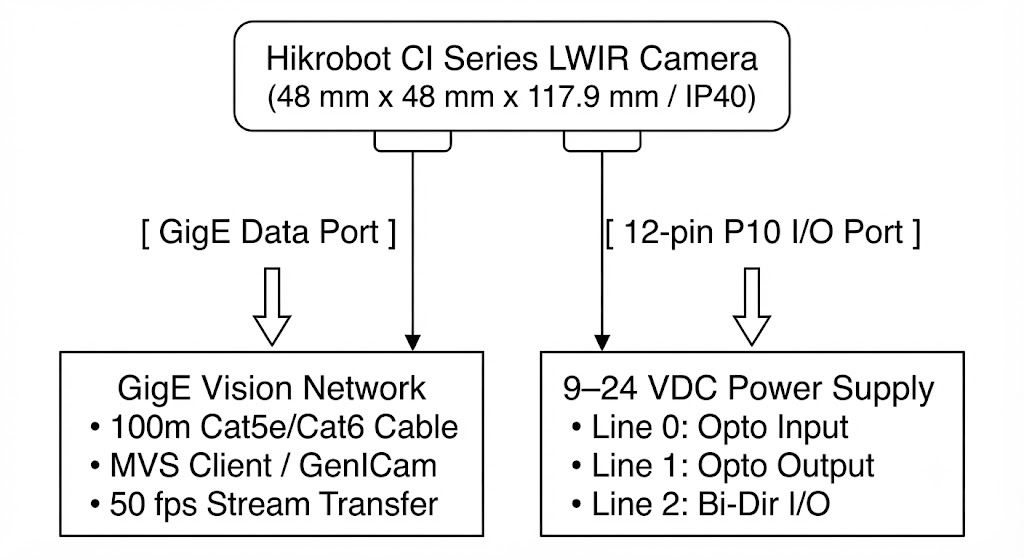
| Communication Interface | Gigabit Ethernet (1000 Mbit/s), GigE Vision V2.0, GenICam |
| Digital I/O | 12-pin P10 connector (1 Opto Input, 1 Opto Output, 1 Bi-directional I/O) |
| Power Consumption | 9 VDC to 24 VDC (Typ. 2.8 W @ 12 VDC) |
| Housing Dimensions & Weight | 48 mm × 48 mm × 117.9 mm; ~370 g |
Radiometric Temperature Analysis & Features
Unlike basic thermal imaging cameras that merely output qualitative visual false-color streams, the Hikrobot CI Series functions as a fully calibrated radiometric measurement device. The camera embeds calibrated temperature data directly into each pixel payload using Float 32 or Mono 16 raw data formats.
Onboard Temperature Measurement Rules
The firmware embedded within the camera supports flexible region-of-interest (ROI) configuration without requiring dedicated external host processing software:
- Multi-Geometry Tools: Real-time measurement rules can be defined using points, lines, circles, and irregular polygons.
- Single & Multi-Region Alarms: High/Low temperature threshold alarms can be set across individual zones or prioritized regions, triggering instant hardware I/O outputs when thermal limits are violated.
- Dynamic Palette Modes: Includes 14 customizable pseudocolor palettes for visual contrast enhancement—including White Hot, Black Hot, Rainbow, Ironbow 1 & 2, Fusion 1 & 2, Ice Fire, Rain, Green Hot, and Red Hot.
Manual vs. Automatic Thermal Scaling
In dynamic thermal environments, auto-scaling palettes can obscure critical comparative defects because the color scale continuously shifts based on the absolute minimum and maximum temperatures in the frame. For strict benchmark testing, the CI Series supports fixed manual scaling. By establishing absolute hot/cold temperature references against a known good baseline sample, inspectors can reliably identify fine variations, seal leaks, or heat dissipation anomalies across high-speed production batches.
Electrical & Hardware Integration
The CI Series chassis is engineered for deployment within cramped machinery cells and hostile automation environments.
Primary Industrial Applications
1. Food Packaging & Heat-Seal Integrity Verification
In high-speed food processing—such as ready-meal production lines—verifying the seal integrity between plastic trays and protective top foils is vital to ensure shelf life and prevent bacterial contamination. Traditional vision systems cannot see through opaque foil or printed film overlays.
By applying LWIR thermal imaging immediately after the heat-sealing stage, trapped sauce, debris, or micro-leaks appear as distinct thermal signatures due to thermal mass differences. Using fixed manual temperature limits set against a control baseline, the CI camera instantly triggers reject gates when seal temperature uniformity is breached.
2. Lithium Battery & Automotive Components Inspection
During lithium battery module assembly, spot welding and cell busbar interconnects generate critical thermal signatures. Thermal profiling identifies poor weld joints, abnormal internal cell resistance, and heat dissipation failures before battery packs progress to final casing stages.
3. Photovoltaics & Solar Wafer Manufacturing
Solar cell manufacturing relies on thermal detection to spot microscopic structural cracks, shunts, and localized electrical hot spots under powered testing. The high NETD (< 50 mK) of the CI Series captures slight resistive heating changes across silicon wafers.
4. Continuous Process Monitoring & Fire Prevention
Beyond part-by-part quality inspection, the CI Series functions as an automated safety monitor in recycling plants, hazardous material storage areas, and high-voltage electrical enclosures. Built-in multi-region temperature alarms operate continuously to notify facility SCADA systems before thermal runaways occur.
Software Support & Integration
The Hikrobot CI Series operates natively within the MVS (Machine Vision Software) suite and supports secondary development across standard programming environments:
- Protocol Compliance: Fully compatible with GigE Vision V2.0 and GenICam standards, facilitating plug-and-play operation with third-party visual processing software like OpenCV, Halcon, and LabVIEW.
- Cross-Platform Software Development (SDK): Provides C, C++, C#, and Python SDKs for Windows (32/64-bit) and Linux systems.
For technical inquiries, lens evaluations, or loan unit arrangements across the UK and Ireland, contact the smartcameras.ai/ engineering team at techsupport@smartcameras.ai.